How I’m Conducting Influencer Marketing Data and Research with a Small Marketing Team
And how I’m using AI and tools like UpDog to make the process repeatable instead of guesswork.
There are so many factors that go into choosing an influencer to partner with, and yet the first metric most teams look at is follower count (how many of us have been personally victimized by follower count? Probably more than a few of us.) Follower count cannot be the beginning and end of a brand’s influencer marketing efforts. A large number of followers does not automatically translate into strong engagement or real impact.
As I’ve been building an influencer shortlist from scratch for a current brand project, one pattern has become obvious: the bigger creators I've found often have lower engagement rates or lopsided audience quality compared to smaller accounts. That’s especially important for small teams and budget‑conscious managers. You want to make sure what you’re paying for actually reaches your ideal customer. Just because an influencer has tons of followers doesn’t mean their people are engaging with the content, or even seeing it in the first place.
So if follower count isn’t the thing, what actually matters when you’re vetting creators?
What Actually Matters When You’re Vetting Creators:
Relevance
Does this creator make content your audience will actually stop scrolling for? Not “in the same vague industry,” but truly aligned with the interests, problems, or aspirations of the people you’re trying to reach.
Audience Fit
Does their following match your ideal customer profile—role, interests, and platform behavior? If you’re trying to reach marketing managers, but most of their audience is made up of general lifestyle followers, I'ma tell you right now, that's not gonna work.
Engagement Quality
Are they getting comments, shares, and saves that show real interest and conversation? Or is it mostly bots, generic “so cute!!” comments, or random emojis? Personally, I care more about thoughtful comments from the right people than a sea of low‑quality engagement.
Consistency
Are they posting regularly and showing up for their audience, or was that big spike in engagement a one‑off moment from months ago? Consistency tells me more about what I can expect during a campaign.
Channel Fit
Are they stronger on TikTok or Instagram, and does that match the campaign we’re running? A creator might have “bigger” numbers on TikTok but a far more engaged, community‑driven audience on Instagram. That matters more than the top‑line follower comparison.
The Tool I'm Using to View Creator Metrics:
One of the coolest tools I discovered in this process is a Chrome extension called UpDog Marketing. No, that’s not a joke. It’s a real platform, and once you install it, it quietly lives in your browser while you research creators.
Here’s what it does for me when I open a TikTok or Instagram profile:
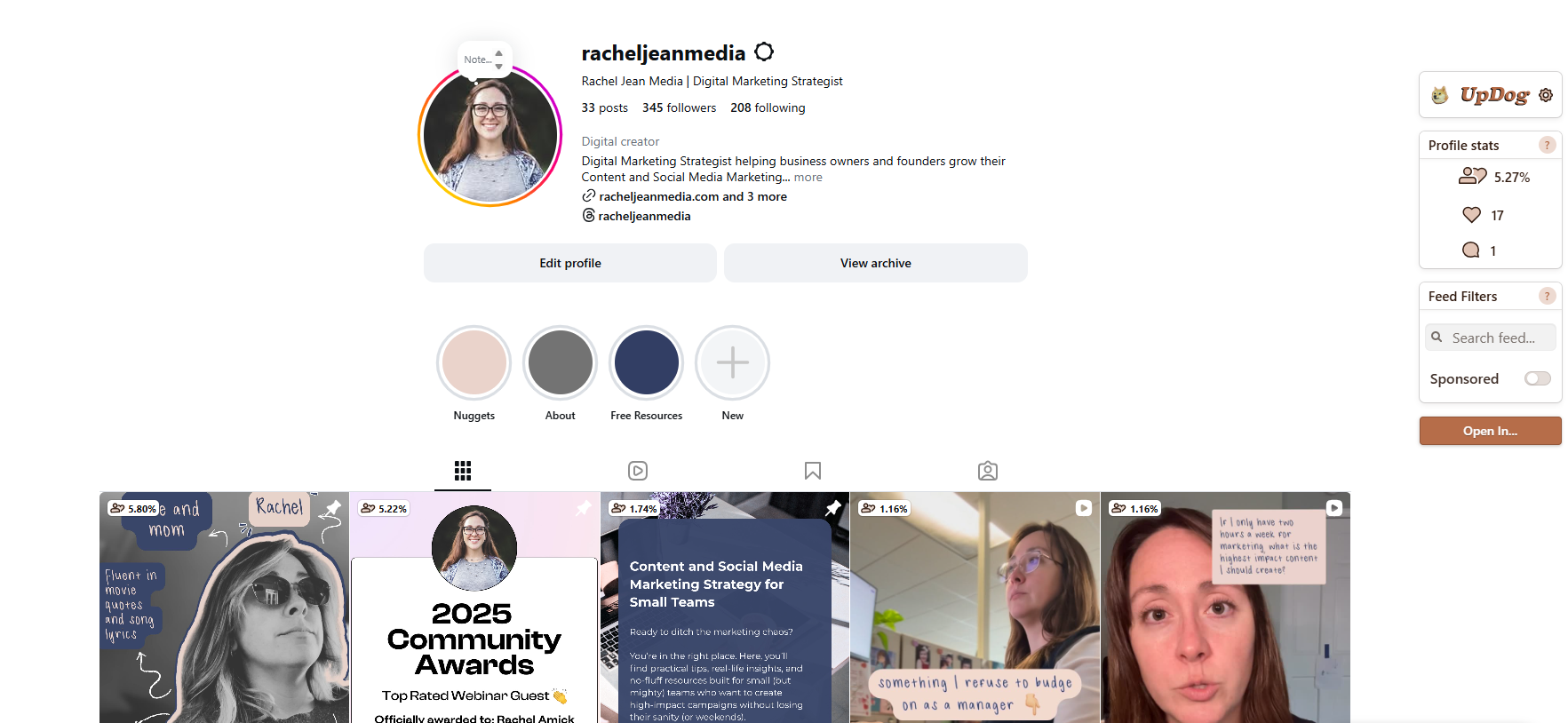
Engagement rate
Average views per post
Average likes
Average comments
Average shares
For example, I might see a creator with thousands of followers on TikTok and only hundreds on Instagram, but their engagement rate on Instagram is significantly higher than on TikTok. Without a tool like this, I’d probably default to the bigger platform and assume that’s where the value is. Instead, I can see in a second where their audience is actually dialed in.
The extension takes up a tiny portion of my screen and saves me from manually tallying stats or hopping between multiple tools. It gives me a quick, well‑rounded snapshot so I can move faster and make decisions with more context.
How I’m Building My Influencer Shortlist (and How You Can Steal the Playbook)
Now let’s talk about the actual system I’m using to build my shortlist—and how you can adapt it.
Step 1: Start with 3–5 “ideal” creators
I start by identifying 3–5 creators who feel like an almost perfect fit:
They align closely with the brand.
Their content themes overlap with what we want to talk about.
Their audiences map well to our ICPs.
These first few are my “anchor” creators. They help set the standard for the kind of partners I want more of.
I ask it to:
Find more creators “like this” in the same niche.
Surface similar accounts talking to the same or adjacent audiences.
Speed up the process of checking public information, so I’m not opening 30 tabs and manually scanning each one.
I’ll use targeted prompts like:
“Find creators in [niche] who talk to [audience].”
“Find TikTok and Instagram creators similar to [handles] who create [type of content] for [type of audience].”
It really is that simple and saves so much time researching. This doesn’t replace my judgment. It just gets me a longer, more relevant candidate list way faster than if I were doing it all manually.
Step 3: Vet the AI suggestions with UpDog
Once I have a list of potential creators, I don’t just accept them at face value.
For each profile I’m considering, I:
Open their TikTok or Instagram
Use UpDog to quickly scan:
Add key metrics to a working spreadsheet
Immediately, I can rule out accounts that look good at a glance (big follower count, nice aesthetic) but clearly underperform on engagement or audience quality.
That said, I don’t automatically disqualify a creator just because they have a higher follower count and a slightly lower engagement rate. I take that as a sign to dig deeper:
Is their content actually strong and aligned with the brand?
Are they doing a good job of engaging in their comments?
Does it look like they’ve grown quickly, and the audience is still “catching up” on engagement?
I use metrics as a filter and not a final verdict.
Step 4: Prioritize with a simple scoring system
Once I’ve reviewed a batch of creators, drop them into a prioritized list and score them on:
Brand/audience fit
Engagement quality
Content quality
Channel fit for this specific campaign
The highest‑scoring creators move to my “shortlist.” Others get parked in a “maybe later” tab so I can revisit them for future campaigns.
The most important part: don’t judge in isolation
The most important part of this whole process is refusing to judge creators based on any one metric in isolation.
I’m not just looking at:
Follower count
Engagement rate
I’m also intentionally looking at:
The quality of their engagement and community management in the comments.
The quality of the content itself (is it a good video, is the production quality and value something I want represented of the brand I'm working with, does it make sense for the brand to sit next to this?)
Tools and AI should speed up my thinking, not replace it. They help me gather information faster and surface patterns, but my human judgment is what makes the final call.
The best part: once you’ve gone through this process, you have a repeatable system you can run again and again without having to rebuild from scratch. Your shortlist spreadsheet becomes an asset, not just a temporary project file
Free assets you can steal right now
If you’ve made it this far, I want to give you some assets you can use immediately, especially if you don’t have access to influencer marketing software, you’re a small startup, or you’re a one‑person marketing team.
Influencer Vetting Checklist:
This checklist will help you:
Decide if a creator is a good fit for your audience and goals.
Track engagement rates in a simple, structured way.
Double‑check that their content aligns with your brand, topic, and values.
Remember to review comment quality, so you’re partnering with a real human who actually engages their community.
Influencer Tracking Spreadsheet and AI Starter Prompts:
This is the spreadsheet format I’m using to track:
Creators across TikTok, Instagram, and YouTube Shorts
Key metrics and notes
Status (shortlist, maybe, later, no)
It also includes a few starter prompts in separate tabs that you can use to:
Describe your ideal creator
Ask AI to find more “lookalike” creators
Speed up your research without letting AI replace your judgment
Use these as a starting point, then tweak them for your team, your brand, and your campaigns. The goal isn’t to chase the biggest follower count, but to build a system that consistently connects your brand with the right people, in the right places, with content that actually converts to leads.